January 13 2012, Mickey Doft
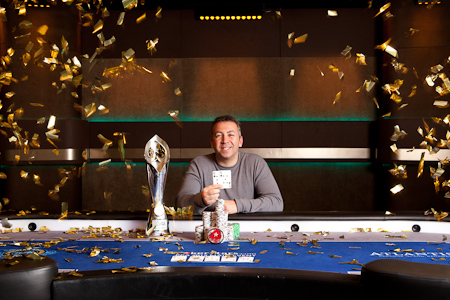
After seven days of tournament-poker action, a winner was crowned in the 2012 PokerStars Caribbean Adventure Main Event. John Dibella, who began the final table fifth in chips, emerged victorious.
Ruben Visser started the table fourth in chips, but had what he called the worst seat at the table. With the big stacks on his left and the short stacks on his right, Visser wasn’t in the ideal position and he was the first to fall. He lost a good portion of his stack when Mark Drover moved all-in with 
 for about nine big blinds. Visser called from the big blind with
 and although he flopped a flush draw, his hand never improved. He bowed out soon after when his
 lost a race to Kyle Julius’
 when a queen hit the flop.
David Bernstein exited next when he three-bet shoved 
 into Dibella’s
 and he was soon followed out the door by Anthony Gregg. Entering the final table as the short stack, the 2009 PCA Main Event runner-up fought hard, but ran
 into Xuan Liu’s
 . Gregg picked up a flush draw on the turn, but did not connect and finished in sixth place.
Mark Drover, at one point during the early stages of the final table, had a mere three big blinds left in his stack. However, four double-ups brought him back in the game before ultimately busting in fifth place. With 
 , Drover’s three-bet shove was met by a call from Faraz Jaka who tabled
 . No help came for Drover and four players remained heading into the dinner break.
The first hand back from dinner was Xuan Liu’s last. She moved in on the button with 
 and was called by Jaka in the big blind with
 . A cruel


 board sealed Liu’s fate as the fourth-place finisher.
Jaka and Julius traded turns as the chip leader during three-handed play before the two tangled in a game-changing hand. A preflop raising war between Jaka and Julius ensued, culminating with Jaka five-bet shoving 
 into Julius’
 . An
. An 


 flop locked up the double for Julius.
Jaka doubled on the following hand, but soon thereafter, a huge turning point occurred that gave John Dibella the chip lead. Jaka opened the pot with a raise on the button holding 
 . Dibella, in the small blind, three-bet with
 . Julius woke up with
 in the big blind and smooth-called. With the feeling he was beat, Jaka ducked out of the way and allowed his two opponents to see an

 flop. Dibella check-called with his set before filling up on the turn when the
  fell. A check-raise jam from Dibella got both players’ chips into the pot and Julius did not catch up on the river.
Jaka hit the rail shortly thereafter when his 
 fell to Julius’
 after the board ran out


 .
.
Dibella began heads-up play with 18,585,000 to Julius’ 13,105,000, and did not relinquish that lead. He finished it off when Julius bluff-raised the river of an 


 with
with 
 . Unfortunately for him, Dibella rivered a flush with
 .
.
With this win, Dibella, a 43-year-old stock trader from Westcherster County in New York, demolished his previous largest cash, a 60th-place finish in the 2008 PCA Main Event worth $16,000.
Final Table Payouts
| *1 | John Dibella | USA | $1,775,000 |
| *2 | Kyle Julius | USA | $1,500,000 |
| 3 | Faraz Jaka | USA | $755,000 |
| 4 | Xuan Liu | Canada | $600,000 |
| 5 | Mark Drover | Canada | $468,000 |
| 6 | Anthony Gregg | USA | $364,000 |
| 7 | David Bernstein | Canada | $260,000 |
| 8 | Ruben Visser | The Netherlands | $156,600 |
*denotes heads-up deal leaving $275,000 to the winner
Although PokerNews’ coverage of the PCA Main Event has concluded, we’ll be back with the PCA High Roller Final Table Saturday. Check out our Live Reporting pages for all of the action.
Follow us on Twitter for up-to-the-minute news.
Follow Mickey Doft on Twitter – @mrdoft
December 18 2011, Donnie Peters, Chad Holloway
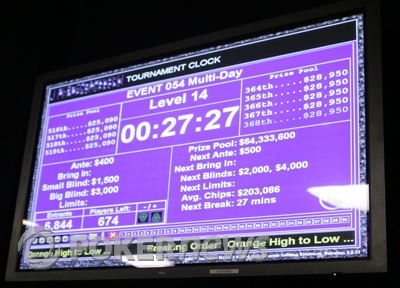
Last week, the World Poker Tour drew the ire of many poker pros when the 2011 Doyle Brunson Five Diamond World Poker Classic drew 413 players. Although that wasn’t a problem in and of itself, the fact that the tournament was slated to payout 25 percent of the field if 400 players entered, a standard practice for the Bellagio for a few years now, was the real problem.
Had the WPT Five Diamond World Poker Classic gotten just 399 entrants, fewer players would have gotten paid and first place would have earned $986,926, if it reached 400, the plan was to pay 100 spots with first earning $794,624. This year, many poker pros took to their social media outlets to express their displeasure with so many players being paid, a sharp contrast to the industry standard of paying out 10 percent of the field; for instance, Kevin MacPhee was one player who was none too happy:
The issue of paying out more or fewer players in a tournament seems to be a hot-button issue these days, with some players advocating the payout structure, while others prefer earning more for their buck when they go deep in a tournament. PokerNews’ Live Reporting Manager, Donnie Peters, and Senior Writer, Chad Holloway, have different perspectives on the topic and square off in our latest debate.
Donnie Peters believes it’s better to pay out fewer players in a tournament field.
Poker tournaments provide players with a great opportunity for competition. This isn’t your third-grade talent show where everyone gets a ribbon for competing, this is poker. All players are adults (at least by age) and don’t need to be coddled by awarding them a greater chance of cashing in a poker tournament.
Poker players don’t play tournaments to simply make their money back. Paying out more places forces the prize pool to be spread out thinner. In the recent case of the World Poker Tour Doyle Brunson Five Diamond World Poker Classic held at the Bellagio, the top 100 spots were paid from a starting field of 413. James Dempsey was awarded a first-place prize of $821,612, but it could have been a lot more. In fact, if a more normal payout structure was used, all of the places would have added a lot more weight to the money finishers’ pockets.
One argument that often comes from the host when paying more spots than normal is that it actually benefits the venue or site that is holding the event. Take PokerStars for instance. On the European Poker Tour, it makes sense to pay a little bit larger amount of the field than normal because the payouts are often deposited into the player’s online poker account. Prior to cashing that money out, those players have a very high chance of spending some of it on the site in the available games. When it comes to live events, such as at the Bellagio, this doesn’t seem to make much sense.
The players who fight and scratch for a minimum cash aren’t going to be the ones taking their very small profit and shooting off in the pit. It’s just not going to happen. They’re going to take that money and leave the casino, happy to turn their $500 satellite win into a nice, little payday. Going back to Dempsey and his win, I believe it’s much better to be able to have a $1 million first-place prize rather than have an extra 50 players walking away saying they cashed in a Bellagio WPT. Wouldn’t you rather have the headline read James Dempsey wins WPT Five Diamond for $1,000,000?
It also seems to take away from the spirit of competition. It’s not supposed to be easy to make money playing poker tournaments and the good players and professionals want to win the most money possible. This isn’t going to be happening when prize pools are spread very thin when a quarter of the field is being paid out. In the minds of the pros, just making the money isn’t even worth it in this spot.
And in a sick, twisted sort of way, poker players secretly want the money bubble to really hurt. When making the money is worth two times or more the original buy-in, bubbling a tournament can be very painful mentally and emotionally. Deep down, poker players love this feeling.
Chad Holloway believes it’s better to pay out more players in a tournament field.
The Bellagio is one of the most popular destinations for poker players, both for cash games and tournaments. The latter have proven exceptionally popular, and always draw satisfactory fields; in fact, the venue plays host to the World Poker Tour several times a year, including the $25,000 World Championship. I think one of the reasons the Bellagio has proven so popular, at least in terms of tournament poker, is its generous payout structure.
When playing a tournament, the first goal on every player’s mind is to win; however, another goal on most players’ wish list is to make the money, which is easier to do when more spots are paid. I know I’d be more likely to plop down $10K to play in a big tournament if I knew 25 percent of the field was paid. Even earning a min-cash or getting my money back (which is what happened in the WPT Five Diamond as 100th-51st essentially earned the same amount) would alleviate a lot of pressure, allowing me to prep for a deep run in the event from that point forward.
Deep payout structures remind me a lot of PokerStars 50/50 Tournaments, where players earn double their buy-in once half the field has been eliminated. Such tournaments have proven quite popular online and I wouldn’t be surprised to see a similar format adopted at a live event, though this would be the extreme of any generous payout structure. Pros are always looking for that big score, but the average poker player would be thrilled to double their money.
I’ll admit that the standard 10 percent payout is more amenable for poker pros, but I believe the 25 percent payout structure is more appealing to the poker masses, at least in big buy-in tournaments. Let’s face it, there is a direct correlation between the size of a tournament and the buy-in. Usually the higher the price, the fewer players there are. By paying out more spots, more players will be enticed to enter as they’ll no doubt think it easier to be one of four to cash rather than one out of ten. Given the economic hardships faced by many, and the lackluster poker economy, this is not a time to turn a blind eye to any policy that could possibly attract more players.
Playing tournament after tournament and never cashing can be very demoralizing and discouraging. By easing the criteria to cash, some players may be more apt to play. If they do and get their money back, they’re more than likely going to invest it in another tournament down the road. This is good for everyone involved as players get to play more events, the entries will be up, and the venue will get even more entry fees. Also, let’s not forget about those who satellite into tournaments. To them, a min-cash usually feels like a win in itself and I bet the majority of satellite qualifiers would prefer a 25 percent payout structure.
I don’t believe paying out 25 percent of the field should become the new industry standard, but I do think it is an agreeable option and should be utilized at various stops. Times are tough across the board, and a deeper payout structure is a simple tactic to adapt to a downtrodden poker economy.
Stay up to date on all the latest news by following us on Twitter and liking us on Facebook.
Follow Donnie Peters on Twitter – @Donnie_Peters
Follow Chad Holloway on Twitter – @ChadAHolloway


ROUND Pool Tables

Online Poker Training Center (Website)
Poker Master Mind (Book)
Lord Of Poker (Software)
Online Poker Strategies (Video Training)
Become A Poker Dealer (Books, Videos, photos, etc)
The Latest Poker News
- Two Plus Two Poker Strategy Magazine – October 2014 Publisher Note – by Mason Malmuth
- Two Plus Two Poker Strategy Magazine – June 2014 Publisher Note – by Mason Malmuth
- Two Plus Two Poker Strategy Magazine – April 2014 Publisher Note – by Mason Malmuth
- Two Plus Two Poker Strategy Magazine – March 2014 Publisher Note – by Mason Malmuth
- Two Plus Two Poker Strategy Magazine – February 2014 Publisher Note – by Mason Malmuth
- A Cautionary Tale for Prospective Small Stakes Poker Professionals – by Carlos Welch
- Two Plus Two Poker Strategy Magazine – January 2014 Publisher Note – by Mason Malmuth
- LiveAce – Competitive and Legal US Online Poker – by Adam Stein-Sapir
- Two Plus Two Poker Strategy Magazine – November 2013 Publisher Note – by Mason Malmuth
- World Series of Poker Trip Report, Part 4 – by Andrew Brokos
Poker Videos

Full Tilt Poker Exclusive Offers

Victory Poker Exclusive Offers
Victory Poker Model Videos
PokerStars Exclusive Offers
