December 18 2011, Donnie Peters, Chad Holloway
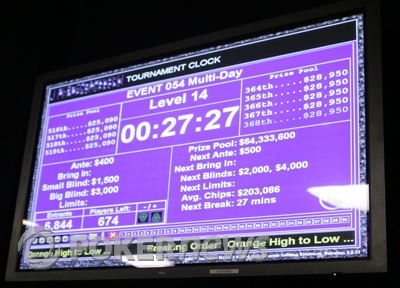
Last week, the World Poker Tour drew the ire of many poker pros when the 2011 Doyle Brunson Five Diamond World Poker Classic drew 413 players. Although that wasn’t a problem in and of itself, the fact that the tournament was slated to payout 25 percent of the field if 400 players entered, a standard practice for the Bellagio for a few years now, was the real problem.
Had the WPT Five Diamond World Poker Classic gotten just 399 entrants, fewer players would have gotten paid and first place would have earned $986,926, if it reached 400, the plan was to pay 100 spots with first earning $794,624. This year, many poker pros took to their social media outlets to express their displeasure with so many players being paid, a sharp contrast to the industry standard of paying out 10 percent of the field; for instance, Kevin MacPhee was one player who was none too happy:
The issue of paying out more or fewer players in a tournament seems to be a hot-button issue these days, with some players advocating the payout structure, while others prefer earning more for their buck when they go deep in a tournament. PokerNews’ Live Reporting Manager, Donnie Peters, and Senior Writer, Chad Holloway, have different perspectives on the topic and square off in our latest debate.
Donnie Peters believes it’s better to pay out fewer players in a tournament field.
Poker tournaments provide players with a great opportunity for competition. This isn’t your third-grade talent show where everyone gets a ribbon for competing, this is poker. All players are adults (at least by age) and don’t need to be coddled by awarding them a greater chance of cashing in a poker tournament.
Poker players don’t play tournaments to simply make their money back. Paying out more places forces the prize pool to be spread out thinner. In the recent case of the World Poker Tour Doyle Brunson Five Diamond World Poker Classic held at the Bellagio, the top 100 spots were paid from a starting field of 413. James Dempsey was awarded a first-place prize of $821,612, but it could have been a lot more. In fact, if a more normal payout structure was used, all of the places would have added a lot more weight to the money finishers’ pockets.
One argument that often comes from the host when paying more spots than normal is that it actually benefits the venue or site that is holding the event. Take PokerStars for instance. On the European Poker Tour, it makes sense to pay a little bit larger amount of the field than normal because the payouts are often deposited into the player’s online poker account. Prior to cashing that money out, those players have a very high chance of spending some of it on the site in the available games. When it comes to live events, such as at the Bellagio, this doesn’t seem to make much sense.
The players who fight and scratch for a minimum cash aren’t going to be the ones taking their very small profit and shooting off in the pit. It’s just not going to happen. They’re going to take that money and leave the casino, happy to turn their $500 satellite win into a nice, little payday. Going back to Dempsey and his win, I believe it’s much better to be able to have a $1 million first-place prize rather than have an extra 50 players walking away saying they cashed in a Bellagio WPT. Wouldn’t you rather have the headline read James Dempsey wins WPT Five Diamond for $1,000,000?
It also seems to take away from the spirit of competition. It’s not supposed to be easy to make money playing poker tournaments and the good players and professionals want to win the most money possible. This isn’t going to be happening when prize pools are spread very thin when a quarter of the field is being paid out. In the minds of the pros, just making the money isn’t even worth it in this spot.
And in a sick, twisted sort of way, poker players secretly want the money bubble to really hurt. When making the money is worth two times or more the original buy-in, bubbling a tournament can be very painful mentally and emotionally. Deep down, poker players love this feeling.
Chad Holloway believes it’s better to pay out more players in a tournament field.
The Bellagio is one of the most popular destinations for poker players, both for cash games and tournaments. The latter have proven exceptionally popular, and always draw satisfactory fields; in fact, the venue plays host to the World Poker Tour several times a year, including the $25,000 World Championship. I think one of the reasons the Bellagio has proven so popular, at least in terms of tournament poker, is its generous payout structure.
When playing a tournament, the first goal on every player’s mind is to win; however, another goal on most players’ wish list is to make the money, which is easier to do when more spots are paid. I know I’d be more likely to plop down $10K to play in a big tournament if I knew 25 percent of the field was paid. Even earning a min-cash or getting my money back (which is what happened in the WPT Five Diamond as 100th-51st essentially earned the same amount) would alleviate a lot of pressure, allowing me to prep for a deep run in the event from that point forward.
Deep payout structures remind me a lot of PokerStars 50/50 Tournaments, where players earn double their buy-in once half the field has been eliminated. Such tournaments have proven quite popular online and I wouldn’t be surprised to see a similar format adopted at a live event, though this would be the extreme of any generous payout structure. Pros are always looking for that big score, but the average poker player would be thrilled to double their money.
I’ll admit that the standard 10 percent payout is more amenable for poker pros, but I believe the 25 percent payout structure is more appealing to the poker masses, at least in big buy-in tournaments. Let’s face it, there is a direct correlation between the size of a tournament and the buy-in. Usually the higher the price, the fewer players there are. By paying out more spots, more players will be enticed to enter as they’ll no doubt think it easier to be one of four to cash rather than one out of ten. Given the economic hardships faced by many, and the lackluster poker economy, this is not a time to turn a blind eye to any policy that could possibly attract more players.
Playing tournament after tournament and never cashing can be very demoralizing and discouraging. By easing the criteria to cash, some players may be more apt to play. If they do and get their money back, they’re more than likely going to invest it in another tournament down the road. This is good for everyone involved as players get to play more events, the entries will be up, and the venue will get even more entry fees. Also, let’s not forget about those who satellite into tournaments. To them, a min-cash usually feels like a win in itself and I bet the majority of satellite qualifiers would prefer a 25 percent payout structure.
I don’t believe paying out 25 percent of the field should become the new industry standard, but I do think it is an agreeable option and should be utilized at various stops. Times are tough across the board, and a deeper payout structure is a simple tactic to adapt to a downtrodden poker economy.
Stay up to date on all the latest news by following us on Twitter and liking us on Facebook.
Follow Donnie Peters on Twitter – @Donnie_Peters
Follow Chad Holloway on Twitter – @ChadAHolloway
December 15 2011, Brett Collson

It’s been more than a month since we last heard from Full Tilt Poker and Groupe Bernard Tapie. However, it appears the two sides are inching closer to a deal that could allow for the repayment of players across the world. We’ll cover that story, as well as the latest from Bodog and Sands CEO Sheldon Adelson, in this edition of the Nightly Turbo.
In Case You Missed It
Phil Hellmuth has been in the news more than usual lately. Hellmuth recently sat down with Chad Holloway to discuss several topics, including his upcoming charity event in Wisconsin.
Erik Seidel (who else?) led the field after Day 1 of the Epic Poker League Main Event. Get all the details from the Palms in our Day 1 recap.
Raffaele Bertolucci bagged the most chips after Day 1b of the World Poker Tour Venice Main Event. However, Day 1a leader Andrea Dato was still on top heading into Day 2.
Jared Tendler is the author of The Mental Game of Poker and coaches many of the game’s top pros. Tendler joined the Strategy with Kristy podcast this week to talk about mental preparation, tilt control, and more.
The Global Poker Index released its rankings as of Dec. 12. Bertrand “ElkY” Grospellier is still No. 1, and a new face has entered the top 10.
Full Tilt Poker, Groupe Bernard Tapie Back in the News
Subject:Poker reported Thursday that a deal has been reached to allow for the transfer of assets Full Tilt Poker (FTP) and French investment firm Groupe Bernard Tapie (GBT).
Sources told Subject:Poker that Full Tilt Poker shareholders ratified an agreement that would allow Groupe Bernard Tapie to purchase the forfeited FTP assets from the DOJ for $80 million. GBT would then be responsible for the repayment of non-U.S. players, and the Department of Justice would repay U.S. players.
Attorneys for Full Tilt Poker and Groupe Bernard Tapie declined comment to PokerNews on Thursday.
Additionally, Spanish News site Poker-Red reported Thursday that Groupe Bernard Tapie was among 61 companies to apply for a Spanish online gaming license before the new regulated market opens in early 2012. PokerStars, bwin.party and 888 were among the other operators to submit applications, but Poker-Red reports that GBT would be forced to replay all Spanish customers at Full Tilt Poker before it could reopen for business.
More on both stories can be found at PokerNews.com.
Adelson Has Many Concerns Regarding Online Poker
Las Vegas Sands CEO Sheldon Adelson became poker’s latest villain after saying he is “morally opposed” to the legalization of online poker in the United States. An excerpt from Adelson’s interview for the January issue of Global Gaming Business (GGB) leaked to Las Vegas Sun columnist Jon Ralston, who blogged about Adelson’s stance last week.
Adelson told GGB that his chief concern is that it will be too easy for underage children to gamble for real money on an Internet poker site. However, he’s also confused by the urge of many casino execs to grab a share in the space.
“PokerStars is the biggest and most successful online gaming entity in the world and the most they made in a year was $440 million,” Adelson said. “Now, how is $440 million divided up amongst several other players going to make a difference? It ain’t going far.”
Adelson says he’s also concerned that online poker could lead to gambling problems for young adults, especially if the operators expand to other gambling avenues. “Poker will absolutely lead to full casinos,” Adelson told GGB.
Read more about Adelson’s opposition to online poker at the Global Gaming Business website.
Operators Granted Online Gambling Licenses in Denmark
On Thursday, PokerStars, 888, bwin.party, PKR and Unibet were among 38 operators to be granted licensed by the Danish Gambling Authority. Each gambling company will be permitted to offer online gambling services to residents of Denmark when the new regulatory framework goes into effect on January 1, 2012.
“From January the gambling market will be orderly and we will ensure that holders of a betting and online casino license to operate on the Danish market also contribute to the society,” said Thor Möger Pedersen, Denmark’s Minister of Taxation. “Danes as well as the many associations supported by the gambling market can be joyful.”
Read more about Denmark’s online gambling licenses at PokerNews.com.
Bodog to Release Software Update With Hand Histories
Bodog has taken heat from players since its online poker room introduced all-anonymous poker tables as part of its new Recreational Poker Model. Among the many concerns raised in the past couple weeks is the potential for opponents to collude due to the inability of players to identify who they’re playing against.
In response, Bodog will be releasing a software update that will allow players to request hand histories if they suspect collusion between opponents. In an interview with CalvinAyre.com, Bodog U.K. CEO Patrik Selin said that the solution is “relatively simple” and will be introduced sometime in the first quarter of 2012.
“When you strip back all of the emotional comments from people with vested interests, whether they be players that use HUDs or are data-mining companies, there is only really one criticism that stands up to scrutiny and that is whether the lack of usernames can increase the opportunity for collusion,” Selin said.
According to Selin, players will be able to request hand histories for any game in which they suspect any wrongdoing. The hand histories will provide the hole cards for each player at the table, and players can then look through the hands and highlight any potential offense to the Bodog security team.
Seems like a lot of complicated busy work for a “recreational” player to take on.

Photo by Michael Polizzi
Check out the full interview at CalvinAyre.com.
Marianela Pereyra joins the World Poker Tour
The World Poker Tour announced Thursday that anchor Kimberly Lansing is headed for maternity leave, which means former Poker After Dark hostess Marianela Pereyra will take over Lansing’s duties beginning with the WPT Venice event in February 2012.
In addition to her hosting role for the now-defunct Poker After Dark, Pereyra has also covered events for ESPN, CBS Sports and Fox Sports. She also served as a sideline reporter for the 2007 World Series of Poker Main Event final table.
“I’m thrilled to be given such an incredible opportunity,” Pereyra said of joining the WPT. “It’s an honor to be filling in for Kimberly Lansing and I’m really looking forward to being part of the World Poker Tour.”
Read more at PokerNews.com.
Bravo!
If you’re in Las Vegas and looking for the juiciest cash games in town, the arrival of a new poker app could help point you in the most profitable direction. VegasChatter.com recently reviewed BravoPokerLive, a GPS-enabled app that provides information for all of the most popular poker rooms in Sin City and around the U.S.
BravoPokerLive is a go-to source for live cash-game players. The app, which is available for both iPhone and Android users, provides real-time information for poker rooms that use the Bravo room management system, such as how many tables are running and the limits at each table. If you’re strolling along the Vegas strip and getting the itch to play some cards, BravoPokerLive lets you check in on the current action in the nearby poker rooms. It’ll even tell you how to get to the nearest room using the app’s GPS features.
The app also provides live info for poker rooms in Los Angeles, Atlantic City, Tunica, and several other casinos across the country.
VegasChatter also reviewed the AllVegasPoker app, which provides schedules for all of the daily tournaments in Vegas along with cash game information similar to BravoPokerLive.
Check out the full reviews at VegasChatter.com.
Are you following PokerNews on Twitter? Like us on Facebook while you’re at it, and sign up for the newsletter. You know you want to.
Follow Brett Collson on Twitter – @brettcollson


ROUND Pool Tables

Online Poker Training Center (Website)
Poker Master Mind (Book)
Lord Of Poker (Software)
Online Poker Strategies (Video Training)
Become A Poker Dealer (Books, Videos, photos, etc)
The Latest Poker News
- Two Plus Two Poker Strategy Magazine – October 2014 Publisher Note – by Mason Malmuth
- Two Plus Two Poker Strategy Magazine – June 2014 Publisher Note – by Mason Malmuth
- Two Plus Two Poker Strategy Magazine – April 2014 Publisher Note – by Mason Malmuth
- Two Plus Two Poker Strategy Magazine – March 2014 Publisher Note – by Mason Malmuth
- Two Plus Two Poker Strategy Magazine – February 2014 Publisher Note – by Mason Malmuth
- A Cautionary Tale for Prospective Small Stakes Poker Professionals – by Carlos Welch
- Two Plus Two Poker Strategy Magazine – January 2014 Publisher Note – by Mason Malmuth
- LiveAce – Competitive and Legal US Online Poker – by Adam Stein-Sapir
- Two Plus Two Poker Strategy Magazine – November 2013 Publisher Note – by Mason Malmuth
- World Series of Poker Trip Report, Part 4 – by Andrew Brokos
Poker Videos

Full Tilt Poker Exclusive Offers

Victory Poker Exclusive Offers
Victory Poker Model Videos
PokerStars Exclusive Offers
