March 09 2011, Chad Holloway, Donnie Peters
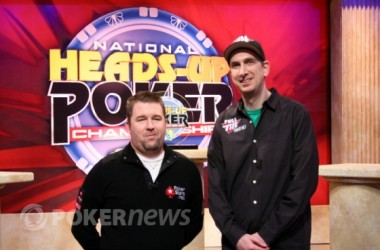
The NBC National Heads-Up Poker Championship recently wrapped with Erik Seidel continuing his 2011 heater by defeating Chris Moneymaker in the finals to claim the $750,000 first-place prize. Both players had a rough road to the championship match that included bouts against internet stars, living legends, cash game specialists, and world champions. While Seidel won the event, one wonders if the road he took to get to the finals was filled with tougher opposition than that of Moneymaker. PokerNews’ own Donnie Peters and Chad Holloway decided to tackle the issue in another PokerNews Debate.
The Road to the Final
| Round 1 | John Racener | Allen Cunningham |
| Round 2 | Daniel Cates | Jen Harman |
| Round 3 | Doyle Brunson | Phil Gordon |
| Quarterfinals | David Oppenheim | Vanessa Selbst |
| Semifinals | Jonathan Duhamel | Andrew Robl |
Chad Holloway thinks Chris Moneymaker drew the more difficult path to the finals.
The 2003 World Series of Poker Main Event Champion has been the poster boy of poker for nearly a decade. Whether people love him or hate him, everyone knows who Moneymaker is and what he has done for the game. In the past few years there has been a great deal of pressure for Moneymaker to put up some results and reestablish his relevance in the game. He helped ease that pressure with an 11th-place finish at the PokerStars Caribbean Adventure in January, but he was still in need of results if he wanted to appease his critics. Enter the NBC National Heads-Up Championship.
Unlike Seidel, whose unbelievable start to 2011 crushed any pressure to perform, Moneymaker was in desperate need of another positive result and there was no better place to make that happen than in a tournament that would be broadcast on national TV. Moneymaker’s Round 1 match was against the latest WSOP runner-up, John Racener. Given Racener had never played the event before and Moneymaker had years of experience, there is no doubt that he was a favorite and had an easier first-round match than Seidel, who had to go through Allen Cunningham.
However, Moneymaker’s Round 2 match, as well as the subsequent rounds, were much tougher. As a reward for defeating Racener, Moneymaker found himself in a match against online-poker juggernaut Daniel “jungleman12” Cates. Here was a man who specialized in playing heads-up no-limit hold’em online at the highest stakes possible. He had played, and often defeated, the likes of Tom “durrrr” Dwan, Patrik Antonius, and Phil Ivey. Granted, Cates’ expertise rested in cash games and not tournaments, but in my opinion he was a big favorite in this match. Moneymaker fought a tough battle and ultimately emerged victorious. One could argue that up to that point Moneymaker had defeated two opponents with absolutely no experience in the NBC Heads-Up Championship, which is true. However, that argument wouldn’t hold true for his next match.
Round 3 was the complete opposite of the prior match. Instead of a young online pro, Moneymaker had to face the “Godfather of Poker,” Doyle Brunson. No one has been in the game longer, or has more experience, than “Texas Dolly,” yet Moneymaker managed to work him over and send him to the rail. Things didn’t get any easier though as Moneymaker was due to face David Oppenheim in the next round. Oppenheim was another high-stakes cash game player with a NBC Heads-Up record of 6-2; nonetheless, it didn’t take long for Moneymaker to defeat Oppenheim with a rivered flush to advance to the semi-finals.
To top it off, the only thing standing between Moneymaker and the finals was the reigning WSOP Main Event Champ, Jonathan Duhamel. The only thing that could have made the match sweeter was if it had been in the finals rather than the semi-finals. When Moneymaker dispatched Duhamel, critics of the 2003 Champ, including myself, were duly silenced. By defeating the players that he did, Moneymaker won me over and proved he’s got what it takes to remain relevant in the game.
Unfortunately, Moneymaker came up just short of the title when he went 0-2 in the finals, which isn’t a surprise considering Seidel is on an unprecedented ten-week heater. Had Moneymaker managed to halt Seidel’s momentum and emerge victorious, I believe it would have been the hardest road to victory in the history of the NBC National Heads-Up Championship.
Donnie Peters thinks Erik Seidel drew the more difficult path to the finals.
Surely, Seidel came into the NBC National Heads-Up Championship on fire. He had already locked up nearly $3.6 million in earnings for 2011 alone. He won both the $250,000 Super High Roller at the Aussie Millions and the L.A. Poker Classic $25,000 High Roller event amongst many other results. If there was ever a favorite going into the NBC event, it was Seidel.
For Seidel’s first matchup, he drew Cunningham — a man who sits eighth on the all-time money list and holds five WSOP gold bracelets. Cunningham is well known and one of the most analytical and calculated professionals in the game. With 26 tournament wins on his resume and 16 second-place finishes, Cunningham has a win rate of just under 62 percent when he gets to heads up in a tournament. Clearly, he knows how to seal the deal. Cunningham is one of the tougher players in this field from the beginning and could rival anyone Moneymaker had to play, giving the first match difficulty factor to Seidel.
As Chad stated above, Moneymaker’s second-round match was against “online-poker juggernaut Cates”. Let’s be sure to point out that there should be extra emphasis on “online” because Cates has amassed less then five figures in live tournament cashes. Yes, he may be an online, heads-up phenom, but there are two glaring problems with that. First, Cates plays heads-up cash games, not tournaments. It’s an entirely different animal. With the blinds always increasing, you have to adjust to your opponent over a shorter period of time. You can’t reload when you want to and you can’t get up and leave.
Second, the NBC event is played live, not online. If you’ve watched Cates play in one of the few live events he’s shown up at, you’ll notice that he is very raw in his live game. Someone who is known heavily for his live game like Moneymaker, can pick up on things much easier and adjust to Cates in a tournament format a lot faster than one may think. Seidel on the other hand was pitted against the best female poker player in the world, Jen Harman. Chad mentioned that Cates has played and defeated the likes of Antonius, Ivey and Dwan, but he may be forgetting that Harman has done much of the same. Does Bobby’s Room ring a bell? Harman was cutting her teeth with these juggernauts long before Cates even knew how to six-bet shove with air. Harman also has experience playing against the famous Andy Beal in some of the largest heads-up cash games the world has ever seen. She’s a much more solid opponent than Cates, although that doesn’t mean somewhere down the line that Cates won’t become a better live heads-up tournament player than Harman. For now though, Harman and her two WSOP gold bracelets should get the nod.
Moving on to match number three, where Moneymaker faced Brunson and Seidel faced Phil Gordon. This one seems the biggest no brainer of them all, it’s easily Moneymaker, although not by much. Gordon is crushed by all of Brunson’s accolades, but the game may be a little past Brunson by now. His stamina lacks and his mind has more than likely taken all the poker it can handle. Sure, Brunson still plays, but his energy and aggression seem to have gone. Gordon may not have the experience that Brunson has, but his mind is much younger. Let’s not forget about how brilliant Gordon is as well, meaning he’ll be able to buckle down and adapt to the game much easier than Brunson would be.
It’s been said that Oppenheim is one of the toughest live heads-up players in the world. That makes it even more of a debate that Seidel had to go through the amazing Vanessa Selbst. Selbst is very aggressive and extremely solid. She’s won over double the money that Oppenheim has in live tournaments and is known as one of the greatest poker minds out there today. Just because Oppenheim frequents high-stakes cash games doesn’t mean Selbst’s heads-up game falls behind his. At the NBC Draw Party for the event, Jason Mercier, among many other pros who attended, said that drawing Selbst could easily be the worst draws they could have. Oppenheim’s name was not thrown around in this light.
Much like Cates, Andrew Robl is an extremely successful online player, especially heads up. What’s more is that Robl has had a lot more live success to the tune of nearly $1.5 million in live earnings, which trumps all that Cates has done in the live realm. Yes, Duhamel has won more money than Robl when you compare the two semifinal matches side by side, but Duhamel binked one insanely large score in the 2010 WSOP Main Event. Robl has been in the game for a lot longer and provided himself a living from it after having dropped out of college. There’s an intimidation factor facing the reigning world champion, but simply winning the WSOP Main Event doesn’t make you the best player in the world. In fact, some WSOP Main Event winners would be thrown into the group of “worst players in the world” not the best ones. Duhamel can’t be put into either category yet, but so far he’s shown promise. All promise is though is just that, promise, and we’ve yet to see what he can really do in this game.
Seidel was forced to overcome players with excellent live records along with ones that are also great online players. Four out of his five opponents hold WSOP gold bracelets while only two held bracelet’s on Moneymaker’s road to the finals. Also, Seidel’s opponents have 46 total tournament wins on record as opposed to the 24 that Moneymaker’s opponents have racked up in their careers. That shows that Seidel’s adversaries are a lot greater at winning during heads-up play, which is exactly what the NBC event was — a heads-up poker tournament.
What do you think? Let us know in our comments section below. And remember, PokerNews can offer you even more. Be sure to follow us on Twitter and like us on Facebook.
March 28 2011, Rich Ryan

Entering this week’s episode of High Stakes Poker, only three players were in the black: Antonio Esfandiari, Andrew Robl and David Peat. Every other player was down at least $100,000, including Bill Klein who was down more the $400,000. The players welcomed the 1987 and ‘88 World Series of Poker Main Event Champion Johnny Chan to the table for the finale of the session, and the “Oriental Express” jumped out to a very fast start.
SPOILER ALERT: If you are waiting to watch the HSP episode, read no further.
Here’s how the table looked at the beginning of the episode.
| Seat 1 | Doyle Brunson | $86,900 | -$113,100 |
| Seat 2 | Vanessa Selbst | $208,900 | -$191,100 |
| Seat 3 | Barry Greenstein | $278,400 | -$121,600 |
| Seat 4 | Antonio Esfandiari | $636,200 | +$436,200 |
| Seat 5 | Andrew Robl | $416,400 | +$116,400 |
| Seat 6 | |||
| Seat 7 | Bill Klein | $379,400 | -$421,600 |
| Seat 8 | David Peat | $407,600 | +$207,600 |
Wasn’t the Pot Raised?: Antonio Esfandiari opened the action to $2,500 with 
 . Bill Klein called with
 on the button, David Peat called with
 from the small blind, and Doyle Brunson came along with
 from the big. The dealer fanned

 , giving Peat and Brunson gut-shot straight draws and Klein top pair. All four players checked, however, and the turn brought the
  .
.
Peat led out for $5,000 with his turned straight. Brunson called, not knowing he was drawing to a split, and Klein raised to $22,000 drawing dead. Peat called and Brunson released. The river was the  , and Peat checked to try and induce a bluff from Klein. Klein quickly checked behind though, and Peat unhappily tabled the best hand.
“Wasn’t the pot raised?” Vanessa Selbst asked upon seeing Peat’s rags.
“I could’ve made two flushes and three or four straights,” Peat answered with a grin.
Esfandiari Turns Nut-Straight, Selbst Rivers Nut-Flush: David Peat limped in with 
 , Vanessa Selbst limped behind with
 , Antonio Esfandiari joined the party with
 , Andrew Robl completed the small blind with
 , and Bill Klein checked his option with
 . Everybody checked after the flop fell

 , and Esfandiari turned the nuts when the
  fell. The action checked to Selbst who coolly tossed out three yellow $1,000 chips, and Esfandiari opted to call rather than raise. Klein and Peat both called, as well, and the river was the
  , giving Selbst the nut flush.
Klein and Peat checked to Selbst who fired another $3,000. Esfandiari quickly bumped it up to $12,000, Klein and Peat got out of the way, and Selbst paused for a moment before reraising to $43,000. Esfandiari went into the tank.
“I can beat a bluff,” Selbst said to him.
“You can beat a bluff?” Esfandiari echoed, before instantly mucking his hand.
Here Comes Johnny!: Ten-time WSOP bracelet winner Johnny Chan joined the table after the first commercial break. The players gave him a very warm welcome and Chan got busy on his very first hand.
Selbst open-limped with 
 , Chan, who chose to post the blind in the cutoff seat, checked with
 . David Peat completed from the small blind with
 , and Doyle Brunson checked his option with
 . The flop fell

 and the blinds checked to Selbst who fired $2,000. Chan called, the two others folded, and the turn was the
  . Both players checked.
The  on the river gave Chan a straight, and after Selbst checked, he bet $4,000. Selbst quickly folded, and Chan raked in his first pot at the table.
Folding Trip Aces: Bill Klein straddled to $1,600, and David Peat was first to act, limping with 
 . The action folded to Antonio Esfandiari who also called with
 , Johnny Chan called with
 from the big blind, and Klein checked his option in the straddle with
 . The flop came down

 and the action checked to Esfandiari who bet $4,200. Only Chan called.
The turn was the  and both players checked, but after the
  spiked on the river, Chan immediately tossed out $20,000.
“Oh Johnny,” Esfandiari sighed.
He tanked for less than half-a-minute before folding his trip aces, saving himself 20 dimes.
Doyle Felted: David Peat straddled to $1,600, and Doyle Brunson started the action by raising to $4,700 with 
 . Vanessa Selbst three-bet to $14,000 with
 , and the action folded back to Brunson who called. The flop was a good one –

 . Brunson checked, fully expecting to check-raise all in, but Selbst checked behind. The turn was the
  , and Brunon checked again, but this time Selbst bet $17,400.
“I guess you turned three kings,” Brunson announced. “But I’m going in.”
He moved all in for $55,300, and Selbst threw her arms up.
“Does that speech mean you have trip jacks?” she said. “I call.”
Selbst was relieved to see that Brunson did not have trip jacks, and the two decided to run it twice. Neither the  nor the
  made Brunson’s flush, and he was forced to re-buy for another $200,000.
Chan Rivers Another Straight: Johnny Chan opened to $3,000 with 
 and was called by Bill Klein (
 ), David Peat (
 ) and Vanessa Selbst (
 ). The flop was

 and Chan continued for $11,000. Only Selbst called.
The turn was the  , and both players checked. The river was the
  , and Selbst checked a third time. Chan fired $15,000, Selbst tank-called and Chan tabled his straight. Selbst looked very confused as she mucked her hand, and Chan raked in yet another pot.
High Stakes Legends: This week, HSP paid tribute to Betty Carey – one of the most feared cash-game players in the late ’70s and early ’80s. Amarillo Slim regarded her as the best woman player he’d ever seen. Slim beat Carey heads-up for $100,000, but in a rematch for double the stakes, Carey defeated Slim in under eight minutes.
Quads Are Good: Bill Klein straddled to $1,600 and David Peat limped in with a monster – 
 . Antonio Esfandiari called with
 , Andrew Robl with
 , Chan with
 , and Klein checked with
 . The
. The 

 flop gave Robl a set and everyone checked. The turn was the
  , and again all five players checked. The
  on the river gave Robl quads, and Peat fired $4,000 with his aces. Robl bumped it to $17,000, and Peat begrudgingly folded.
Robl did not show his quads, rather he silently raked in the $30,000 pot.
Last Pot of the Session: Antonio Esfandiari opened to $2,500 with 
 , and David Peat (
 ) and Doyle Brunson (
 ) called. The flop fell

 and all three players checked. The
  on the turn gave Esfandiari a pair of aces, and he fired $5,600. Peat folded, but Brunson raised to $22,600. Esfandiari wasn’t going anywhere, however, and called.
The river was the  and Brunson led for $40,000 into a pot of $53,000. Esfandiari tank-folded, and Brunson was shipped the last pot of the session.
Tune in next week, where a brand new group of players will take their seats, headlined by 2010 WSOP Main Event champion Jonathan Duhamel, the Unibomber Phil Laak and ”Silent” Mike Baxter.
Hey! Go follow us on Twitter and like us on Facebook to keep up with news from all around the poker world!


ROUND Pool Tables

Online Poker Training Center (Website)
Poker Master Mind (Book)
Lord Of Poker (Software)
Online Poker Strategies (Video Training)
Become A Poker Dealer (Books, Videos, photos, etc)
The Latest Poker News
- Two Plus Two Poker Strategy Magazine – October 2014 Publisher Note – by Mason Malmuth
- Two Plus Two Poker Strategy Magazine – June 2014 Publisher Note – by Mason Malmuth
- Two Plus Two Poker Strategy Magazine – April 2014 Publisher Note – by Mason Malmuth
- Two Plus Two Poker Strategy Magazine – March 2014 Publisher Note – by Mason Malmuth
- Two Plus Two Poker Strategy Magazine – February 2014 Publisher Note – by Mason Malmuth
- A Cautionary Tale for Prospective Small Stakes Poker Professionals – by Carlos Welch
- Two Plus Two Poker Strategy Magazine – January 2014 Publisher Note – by Mason Malmuth
- LiveAce – Competitive and Legal US Online Poker – by Adam Stein-Sapir
- Two Plus Two Poker Strategy Magazine – November 2013 Publisher Note – by Mason Malmuth
- World Series of Poker Trip Report, Part 4 – by Andrew Brokos
Poker Videos

Full Tilt Poker Exclusive Offers

Victory Poker Exclusive Offers
Victory Poker Model Videos
PokerStars Exclusive Offers
